
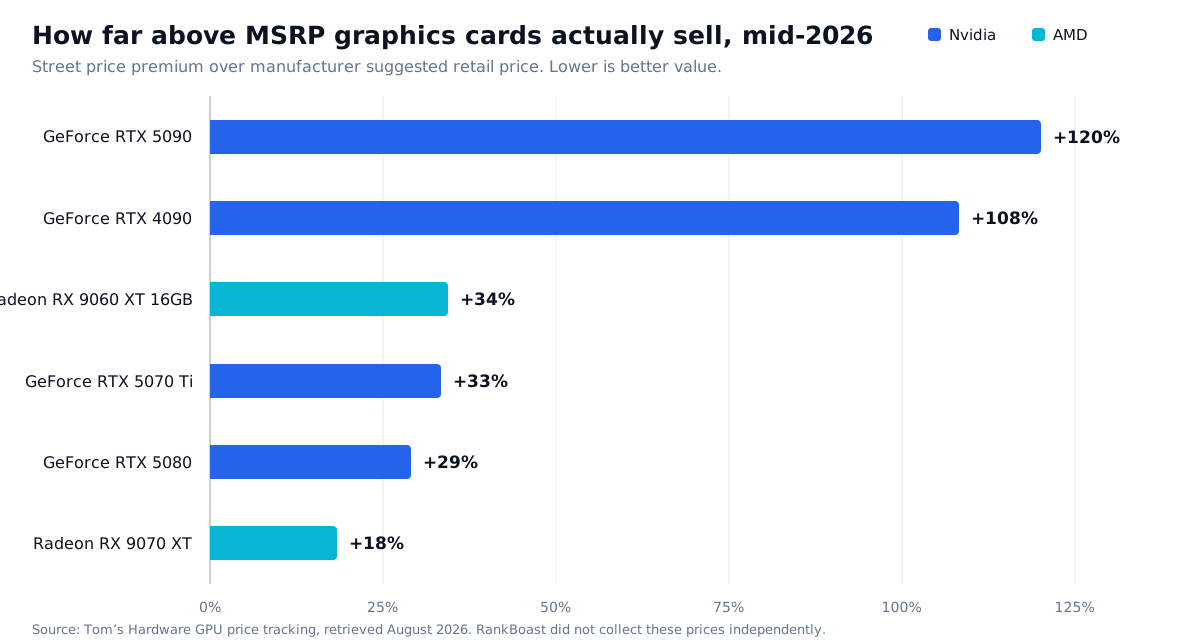
In short: in mid-2026 the question is not which card is fastest, it is how far above MSRP it sells. The premium ranges from about 18% on a Radeon RX 9070 XT to roughly 120% on a GeForce RTX 5090. To choose a graphics card without overpaying, fix your resolution first, then buy the smallest premium available in that tier — and check the price on the day you buy, because MSRP is currently a reference number rather than a price.
Most advice on how to choose a graphics card assumes a functioning market: find the tier you need, pay roughly the recommended price, done. That assumption broke. Memory prices have climbed sharply as data-center AI orders consume DRAM and VRAM supply, and graphics cards have absorbed the cost. Tom’s Hardware, tracking street prices continuously, puts it plainly: most recommended cards “remain at elevated prices compared to their MSRPs, but this is just life in mid-2026.”
That changes the method. When every card carries a premium, the premium itself becomes the variable you can act on — and it is wildly uneven.
The premium is not uniform, and that is the opportunity
Read the chart again by brand rather than by size. Nvidia’s halo cards carry premiums of a different order from everything else, while AMD’s current cards carry the smallest premiums on the board.
| Card | VRAM | MSRP | Street price | Premium |
|---|---|---|---|---|
| GeForce RTX 5090 | 32GB GDDR7 | $1,999 | $4,399 | +120% |
| GeForce RTX 4090 (last gen) | 24GB | $1,599 | $3,329 | +108% |
| Radeon RX 9060 XT 16GB | 16GB | $349 | $469 | +34% |
| GeForce RTX 5070 Ti | 16GB GDDR7 | $749 | $999 | +33% |
| GeForce RTX 5080 | 16GB GDDR7 | $999 | $1,289 | +29% |
| Radeon RX 9070 XT | 16GB GDDR6 | $599 | $709 | +18% |
Prices from Tom’s Hardware price tracking, retrieved August 2026. Percentages are our calculation from those two figures. Street prices move weekly.
Two things follow. First, the last-generation trick has stopped working: an RTX 4090 carries a 108% premium, so buying older hardware is not automatically buying cheaper hardware. Second, the flagship premium is a scarcity charge, not a performance charge. You are not paying 120% more for 120% more frames.
Start with resolution and refresh rate, not the model name
When you choose a graphics card, the tier you need is set by the display you own, not by what reviewers are excited about. Decide two numbers before looking at a single product page: the resolution you actually play at, and the frame rate you actually want to hold.
A 1440p 144Hz monitor and a 4K 60Hz monitor are different problems, and a card that is wasted on one may be inadequate for the other. If you are running 1080p, most of this market is overkill and the money is better spent on the monitor. If you are chasing 4K at high refresh, be honest that this is the tier where the premiums turn brutal.
Write those two numbers down. They convert an unbounded shopping decision into a bounded one.
VRAM is the specification most likely to age badly
Memory is the reason this market is distorted, which makes memory capacity the thing to protect when you choose a graphics card. Look at what the money buys: $469 gets 16GB on a Radeon RX 9060 XT, while $369 gets 8GB on a GeForce RTX 5060.
Capacity is not a performance number in itself — a card with more VRAM is not automatically faster. But it is the specification that determines whether a card still copes in three years, because texture and asset budgets only move upward. In a market where memory is the scarce input, paying a little more for capacity is the least speculative upgrade available.
We are not publishing frame-rate figures here. We have not benchmarked these cards, and inventing numbers to look authoritative is precisely what our review methodology forbids. For measured performance, read a lab that runs the tests.
How to choose a graphics card in five steps
- Fix resolution and target frame rate. Two numbers, written down.
- Identify the tier that clears them using an independent benchmark hierarchy, not marketing material.
- List every card in that tier from all three vendors, Nvidia, AMD and Intel.
- Look up today’s street price for each and calculate the premium over MSRP yourself. It is one subtraction and one division.
- Buy the smallest premium that meets your VRAM floor. Within a tier, cards are close enough in performance that a 15-point difference in premium matters more than a few percent of frame rate.
That last step is the whole article. Performance differences inside a tier are small; price differences inside a tier are currently enormous.
Check these on the day you buy
- Today’s price, not last month’s. These figures moved while this article was being written.
- Power supply headroom and connector type. Confirm your PSU has the right connector, not just the wattage.
- Physical clearance. Card length and slot thickness against your case, measured.
- Display outputs. Confirm the card drives your monitor at its native resolution and refresh rate.
- Warranty and return window, especially buying used or from a marketplace seller.
- The rest of the system. A top-tier card behind a weak CPU or 16GB of system RAM is money spent on a bottleneck.
Common mistakes in this market
Comparing MSRP to MSRP. Every spec sheet and half the reviews quote a price nobody pays. Compare street to street or the comparison is fiction.
Buying the flagship because the review was glowing. Reviews assess performance, and the RTX 5090 is genuinely fast. The review does not price the 120% scarcity premium into its verdict.
Assuming last generation is the value play. It was, for years. At a 108% premium on the RTX 4090, it is not now.
Chasing clock speeds while ignoring capacity. In a memory-constrained market this is exactly backwards.
Buying before you need to. If your current card still clears your two numbers, the strongest move in a distorted market is to wait for it to normalize.
Who should choose what
- Value-focused, 1440p: Radeon RX 9070 XT. The smallest premium on the board at about 18%, with 16GB. Best price discipline currently available.
- Tighter budget, still want 16GB: Radeon RX 9060 XT 16GB at roughly $469. A 34% premium, but the capacity is the point.
- Committed to Nvidia features: RTX 5070 Ti or RTX 5080, at 33% and 29%. Note the 5080 carries the lower premium of the two — worth checking before assuming cheaper means better value.
- 4K at high refresh, professionally justified: RTX 5090, with clear eyes about paying roughly $2,400 above MSRP for availability.
- Everyone else: wait, or buy one tier below what you wanted and put the difference into a monitor or an SSD.
Verdict
In a normal year the way to choose a graphics card is to buy the fastest card your budget clears. In mid-2026 it is to buy the least distorted price that clears your requirement. The RX 9070 XT is the recommendation for most buyers, not because it wins benchmarks but because an 18% premium against a field averaging far higher is the closest thing to a fair price on the board. If you take one habit from this article, take the subtraction: street price minus MSRP, divided by MSRP. It takes ten seconds and it is currently the most informative number in the purchase.
What we would need to test to say more
This is a buying framework, not a performance review. To rank these cards on speed we would need to run them on identical test systems at matched settings, log frame times rather than averages, and repeat under sustained thermal load. We have not done that and do not imply it. What we have done is verify current prices against a source that tracks them continuously, and do the arithmetic.
Sources and methodology
MSRP and street prices are from Tom’s Hardware’s GPU price tracking and best-graphics-cards pages, retrieved August 2026. Premium percentages are RankBoast calculations from those two published figures; the chart is our own work and the underlying numbers appear in the table above so you can check them. VRAM capacities are manufacturer specifications. RankBoast has not benchmarked these cards, did not receive review samples, and publishes no performance figures of its own. Research and drafting for this article were AI-assisted, with every price traced to the linked source. Prices change weekly — verify before buying. Errors are handled under our corrections policy.
Source links
Join the discussion
Add useful context, ask a focused question or share relevant experience. Comments are moderated to protect readers from spam and promotional links.

Leave a thoughtful comment