
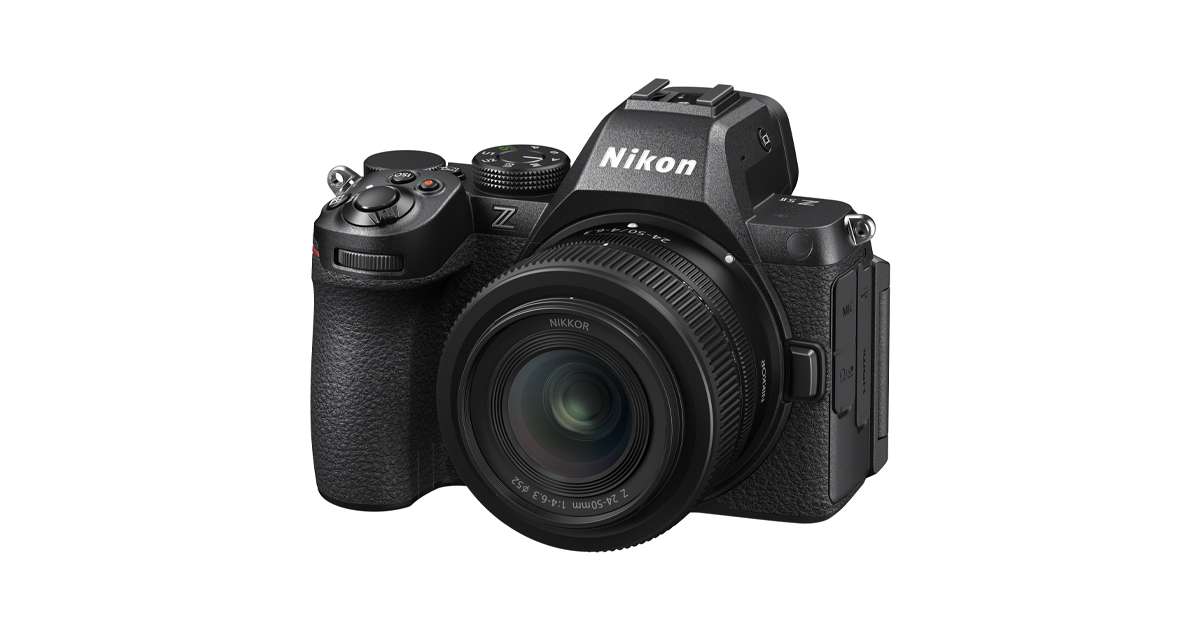
Quick verdict
Nikon Z5II is the strongest new full-frame learning platform here, but many students should spend less on an APS-C body such as a Nikon Z50II or Canon R50 and reserve money for a lens, flash, tripod, storage and printing.
The best cameras for photography students are usually APS-C, because the crop factor makes lenses smaller, lighter and cheaper. A 35mm lens on APS-C frames like a 52mm on full frame — the classic first focal length — and costs a fraction of its full-frame equivalent, leaving budget for light and lenses.
On this page
A first camera should make exposure, focus and light understandable while leaving enough budget to complete assignments. A student does not need the newest full-frame body to learn photography, and the best cameras for photography students are rarely the newest anything.
Student comparison
| Model | Sensor | Why consider it | Budget caution |
|---|---|---|---|
| Nikon Z5II | 24.5MP full frame | IBIS, dual cards, strong controls and long growth path | Full-frame lenses raise total cost and weight |
| Nikon Z50II | 20.9MP APS-C | EXPEED 7 autofocus and lower-cost compact kit | No in-body stabilization |
| Canon EOS R50 | 24.2MP APS-C | Small, accessible controls and effective autofocus | Limited physical controls and no IBIS |
| Used previous-generation body | Varies | More budget for lenses and lighting | Inspect shutter, sensor, battery and return policy |
Ask the course first
Confirm whether the class requires a hot shoe, viewfinder, interchangeable lenses, manual exposure, RAW files, tethering or video. Check which lenses and flashes can be borrowed from the department. Sharing a mount with the equipment room can save more than a small body discount.
Build the complete kit
- Camera and one suitable lens
- Spare battery and reliable card
- Card reader and two-copy backup
- Tripod appropriate to the assignment
- Flash or reflector if the course teaches lighting
- Editing and printing budget
Independent evidence
RTINGS recommends Canon R50 as a budget mirrorless option and reports strong beginner usability, while noting the lack of IBIS. DPReview’s current listing gives Nikon Z5II 91%. These recommendations have different price classes and methods; they should guide a shortlist, not force a purchase.
Why APS-C is often the right answer
Full frame is treated as the goal and it is frequently the wrong starting point. An APS-C sensor is smaller, which multiplies the effective field of view of any lens by roughly 1.5 times. That crop factor is usually described as a limitation; for a student it is mostly an advantage.
Work the numbers. A 35mm lens on APS-C frames like a 52mm lens on full frame — the standard, slightly-normal perspective that most photography courses start with. A 50mm frames like 75mm, the classic portrait length. Both of those lenses exist in inexpensive, light, sharp versions, and both cost dramatically less than the full-frame focal lengths they imitate.
The rest of the trade is honest and small at this stage. Full frame gathers about one stop more light for the same field of view and aperture, and renders shallower depth of field. Neither of those teaches you anything a smaller sensor cannot, and the smaller kit is the one you will actually carry to every class.
So among cameras for photography students, the useful question is not sensor size but whether the mount has an affordable 35mm-equivalent lens and an affordable portrait lens. If it does, the system will support three years of coursework.
Spend on light, not on the body
Course assignments are graded on photographs, and photographs are made of light. A modest body with one good light source will outproduce an expensive body with none, which is the opposite of how most first purchases are allocated.
A useful budget split for a first year is roughly half on the body, a quarter on one good lens beyond the kit zoom, and a quarter on light and support — a single flash with a way to get it off the camera, a reflector, and a tripod that does not wobble. That last quarter is the part students skip and the part that most visibly changes their work.
Check the equipment room before buying any of it. Departments frequently lend lenses, flashes, light stands, backdrops and tripods, and matching your mount to the equipment room’s lenses is worth more than any discount on a body.
The used market, and what to inspect
A previous-generation body in good condition is the highest-value purchase available in this category, and it frees budget for everything above. What to check:
- Shutter count where the body reports it. Mechanical shutters are rated in the low hundreds of thousands; a body well under that has life left.
- Sensor condition. Photograph a plain bright surface at a small aperture such as f/16 and look for dark spots. Dust cleans; scratches do not.
- Every aperture and focus function on any lens included, plus checking for fungus by shining a light through it.
- Battery health, and whether replacements are still sold for the model.
- Card slots, ports and dials exercised individually.
- Return policy. Buy from a dealer with one rather than a private sale for a first camera; the small premium is insurance you will probably not need and cannot do without if you do.
What actually improves your photographs
In roughly descending order of effect during a first year: understanding light and where to stand; one lens used until it is instinctive; shooting frequently rather than occasionally; learning a single editing application properly; and printing your work, which reveals problems a screen hides.
Equipment appears nowhere near the top of that list, and that is not a platitude — it is the reason the comparison table above matters less than the paragraph about the equipment room. The correct choice among cameras for photography students is the cheapest body that meets the course requirements and shares a mount with the lenses you can borrow, because everything left over goes into the things that actually move the work forward.
Sources and methodology
This guide uses official specifications and established independent recommendations. Prices are intentionally omitted because education discounts, used stock and regions change quickly. Verify current pricing on cameras for photography students before committing.
Source links
Join the discussion
Add useful context, ask a focused question or share relevant experience. Comments are moderated to protect readers from spam and promotional links.
Leave a thoughtful comment