
Quick verdict
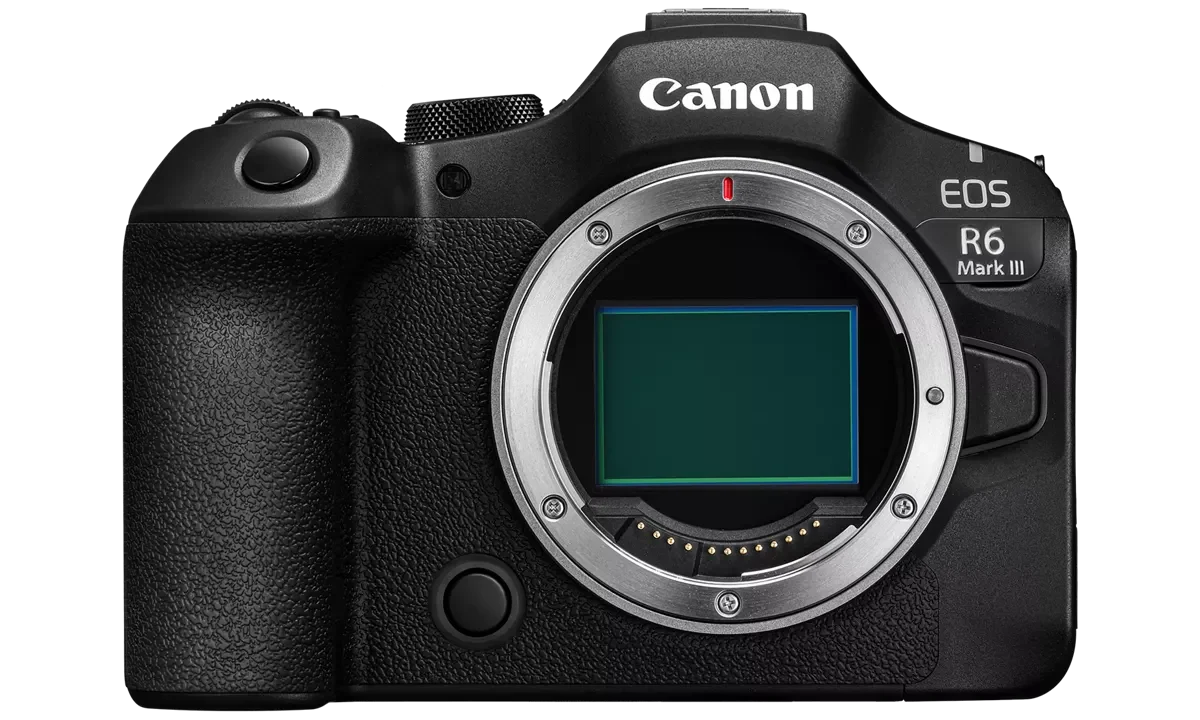
Canon EOS R6 Mark III and Sony a7 V are the strongest current broad sports hybrids in this group. Panasonic S1II offers the highest headline burst, but every electronic-shutter claim needs subject, lens and flicker testing.
Sports photography is limited by buffer and card bandwidth more often than by frames per second. Forty frames a second of 25MB RAW files is a gigabyte per second of sustained writing — far beyond what an SD card can absorb, which is why the headline burst rate collapses after a few seconds on the wrong media.
On this page
Headline burst speed is only one part of a sports system. The camera must focus through the full sequence, read the sensor fast enough to control distortion, clear its buffer, resist venue flicker and work with the right telephoto lens.
Sports comparison
| Model | Maximum burst | Action features | Primary caution |
|---|---|---|---|
| Canon EOS R6 Mark III | 40 fps electronic; 12 fps mechanical | Pre-continuous capture, subject detection, CFexpress + SD | Maximum rates require stated Canon conditions |
| Sony a7 V | 30 fps electronic; 10 fps mechanical | Blackout-free burst, pre-capture, partially stacked sensor | Check full rate with the intended lens and file type |
| Panasonic S1II | 70 fps electronic; about 10 fps mechanical | Pre-burst, phase hybrid AF, blackout-free electronic mode | Headline speed is not the same as sustained RAW depth |
| Nikon Z5II | Up to 15 fps; 30 fps JPEG capture | EXPEED 7 detection, pre-release capture | Lower-cost body with more format limits at top speed |
Test the complete sequence
- Use the actual telephoto lens and subject movement.
- Record RAW until the buffer slows, then time recovery.
- Test LED scoreboards and indoor lighting for banding.
- Check focus hit rate, not only frames per second.
- Confirm battery, card and rain workflow for a full event.
Independent evidence on readout
CineD measured the Sony a7 V’s video readout around 14ms in several modes. That is not a still-photo distortion test, but it confirms that partially stacked does not mean global shutter. Fast lateral motion and electronic shutters still deserve a rental test.
Buffer and card bandwidth
Do the arithmetic that manufacturers leave to you. A full-frame RAW file in the 24–45MP range typically lands somewhere around 25–60MB depending on compression. At 40 frames per second and 25MB per file, the camera must move about 1,000MB every second — one gigabyte — continuously.
No SD card does that. UHS-II tops out at a theoretical 312MB/s, and real sustained write speeds are lower. CFexpress Type B is the reason high burst rates exist at all, and it is why bodies aimed at sports photography carry at least one CFexpress slot while offering SD as the second.
The practical consequences are worth internalizing:
- Peak burst is a buffer specification, not a card specification. The camera writes into internal memory at full speed, then slows to whatever the card can absorb.
- Sustained rate is what you get after the buffer fills — frequently a third or less of the headline figure.
- Recovery time matters more than peak. If the buffer takes fifteen seconds to clear, you have missed the next play.
- Compressed RAW roughly doubles your effective depth. For most sports use the quality difference is invisible and the operational difference is large.
- Putting a slow card in the second slot slows everything if you are writing to both simultaneously.
Flicker, LED boards and indoor venues
Indoor venues are lit by sources that pulse, and LED scoreboards and ribbon displays refresh at their own rates. An electronic shutter reading the sensor progressively can capture different parts of the frame during different phases of that pulse, producing horizontal banding that no amount of editing removes cleanly.
Three defenses. Use the body’s anti-flicker or high-frequency flicker reduction where it exists, and test it in the actual venue rather than trusting the menu item. Fall back to mechanical shutter when banding appears, accepting the lower frame rate. And check the venue before an assignment matters — the same arena can behave differently after a lighting refit.
This is the failure mode that most surprises photographers moving from daylight work into indoor sports photography, because nothing in the specification sheet predicts it.
The spec nobody publishes
The number that would actually rank these cameras is autofocus hit rate — the percentage of frames in a burst that are critically sharp on the intended subject. No manufacturer publishes it, because it depends on the sport, the lens, the light, the subject’s direction of travel and the settings.
You can measure it yourself in an afternoon, and it is worth more than any review. Shoot a hundred frames of the actual sport with the actual lens, then count how many are sharp at 100% magnification on the subject’s eye or the point that matters. Repeat with the alternative body if you can rent one.
A camera delivering 30 usable frames a second at a 70% hit rate outperforms one delivering 40 at 45%, and the specification sheets would tell you the opposite. This is why rental testing is the most cost-effective step available before committing to a system for sports photography.
Sources and methodology
Burst figures are manufacturer maximums with conditions. RankBoast did not conduct an autofocus hit-rate test and therefore does not publish a fabricated percentage.
Source links
Join the discussion
Add useful context, ask a focused question or share relevant experience. Comments are moderated to protect readers from spam and promotional links.
Leave a thoughtful comment