

In short: how to choose a camera is really a question about the lens system you are joining, not the body you are buying. Bodies are replaced every four or five years; lenses and the mount outlive several of them. Pick the system whose lenses you want at prices you can pay, then buy the cheapest body in it that meets your requirements.
Almost every guide to how to choose a camera focuses on bodies, because bodies are what get announced. But the body is the component you will replace soonest and the one that matters least to your pictures in five years’ time. The mount is the commitment.
How we approached this
This is a decision framework built on manufacturer specifications, linked at the end. RankBoast has not tested these cameras and publishes no measurements of its own — see our review methodology. For body-by-body picks see our photography camera shortlist; this article is about the system you buy into.
How to choose a camera: the system outranks the body
Consider what actually happens over a decade. You buy a body and a kit lens. Two years later you add a fast prime. Four years later the body is superseded and you replace it — with another body on the same mount, because your lenses are there. That is how systems work, and it is why the mount decision compounds and the body decision does not.
Changing systems later means selling every lens at a loss and rebuying equivalents. That cost dwarfs any price difference between two bodies you are agonising over today.
Four questions that pick a system
- Which lenses do you actually want, and what do they cost on each mount? Price the two or three lenses you would realistically own within three years, not the body.
- Is there a used market? Older, larger systems have deep second-hand lens supply, which lowers the real cost of ownership substantially.
- Can you borrow or rent locally? A system your friends, course or local shop already stocks is cheaper to experiment with.
- Do third parties make lenses for it? Independent manufacturers add affordable options and put pressure on prices.
Notice that none of those questions mention megapixels. That is deliberate, and it is the core of how to choose a camera sensibly.

Format decides size, cost and depth of field
The sensor format sets the character of the whole system, not just the image. Larger formats give shallower depth of field at equivalent framing and generally better low-light behavior, at the cost of larger, heavier, pricier lenses.
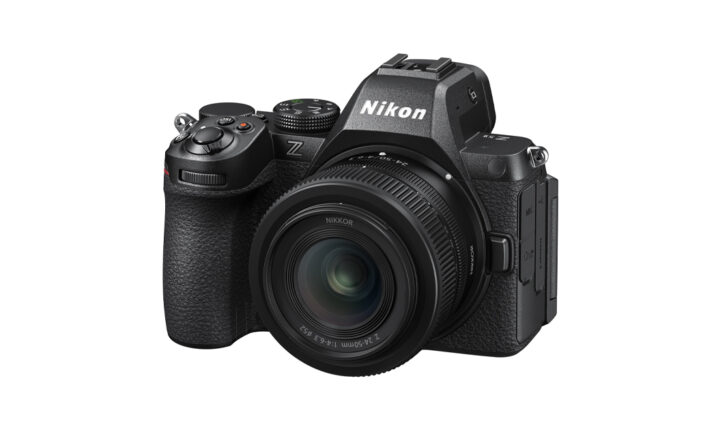
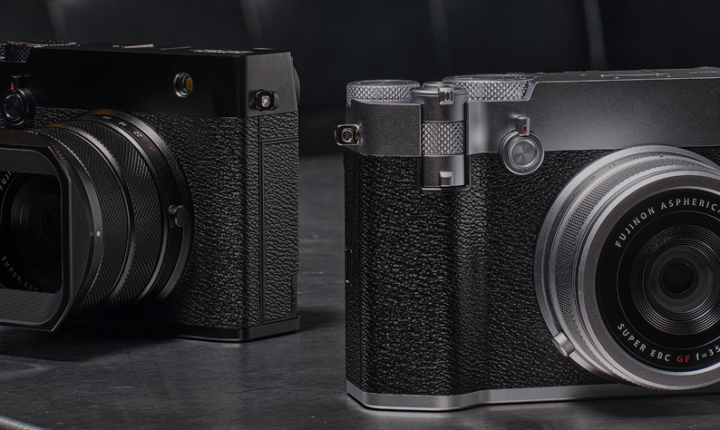
Compare two current bodies to see how far the extremes sit apart. Fujifilm publishes the X-E5, an APS-C body, at approximately 445g including battery and card. Its GFX100RF, with a sensor measuring 43.8 × 32.9mm, is approximately 735g — with a fixed lens, so that weight buys no flexibility at all. Full-frame sits between them: Nikon publishes the Z5II body at around 620g before you attach anything.
For a deeper treatment of the trade-offs see our sensor format comparison.
How to choose a camera body once the system is settled
Once the system is chosen, only a handful of body specifications change how you work.
- Card slots. One or two. Two matters if the photographs are irreplaceable or paid for. The Z5II has two UHS-II slots; the X-E5 and GFX100RF have one each.
- Battery endurance. Wider spread than people expect: Fujifilm rates the X-E5 at roughly 310 frames and the GFX100RF at roughly 820, while Nikon rates the Z5II at about 380 shots.
- In-body stabilization. Present and rated to 7.0 stops center on the X-E5, up to 7.5 stops on the Z5II, and absent for stills on the GFX100RF.
- Viewfinder. 2.36 million dots on the X-E5, 3.69 million at 3000 nits on the Z5II, 5.76 million on the GFX100RF.
- Ergonomics. Unmeasurable and decisive. Hold it before buying.
Common mistakes
Buying a body, then discovering the lenses. Price the lenses first; they are the larger and longer commitment.
Chasing resolution. Beyond a point it costs storage and demands better technique without improving the photograph.
Ignoring the used lens market. Often the single biggest saving available.
Buying a fixed-lens camera without testing the focal length. Shoot your phone locked to one focal length for a week first.
Assuming bigger sensor means better pictures. It means different pictures, heavier lenses and a larger bill.
Who should choose what
- Starting out: an APS-C system with a deep affordable lens range. More money for glass, less for silicon.
- Portraits and events: full frame, for depth of field control and low light. Price the 85mm before the body.
- Travel and street: the lightest system that takes the lenses you want. The X-E5’s 445g is a genuine advantage.
- Studio and landscape: the largest format your budget supports, accepting weight and cost.
- Already own lenses: stay on the mount. Reusing glass is nearly always the better financial decision.
Verdict
Choose the system, then the cheapest body in it that clears your requirements, then spend what is left on lenses. Approached that way, how to choose a camera becomes a question about a decade rather than a season — and it is the approach least likely to leave you selling everything in three years to start again.
What we would need to test to say more
To rank systems we would need matched shooting across bodies and lenses, measured autofocus hit rates on identical subjects, and low-light comparison at fixed exposure. We have not done that. The specifications above are manufacturer values, clearly labeled.
Sources and methodology
All specifications are manufacturer values from the official pages linked below, retrieved August 2026, and stabilization ratings follow the CIPA 2024 standard where the manufacturer states it. RankBoast has not tested these cameras, measured stabilization or autofocus, and received no review samples. Research and drafting were AI-assisted, with every figure traced to the linked source. Errors are handled under our corrections policy.
Source links
Join the discussion
Add useful context, ask a focused question or share relevant experience. Comments are moderated to protect readers from spam and promotional links.
Leave a thoughtful comment